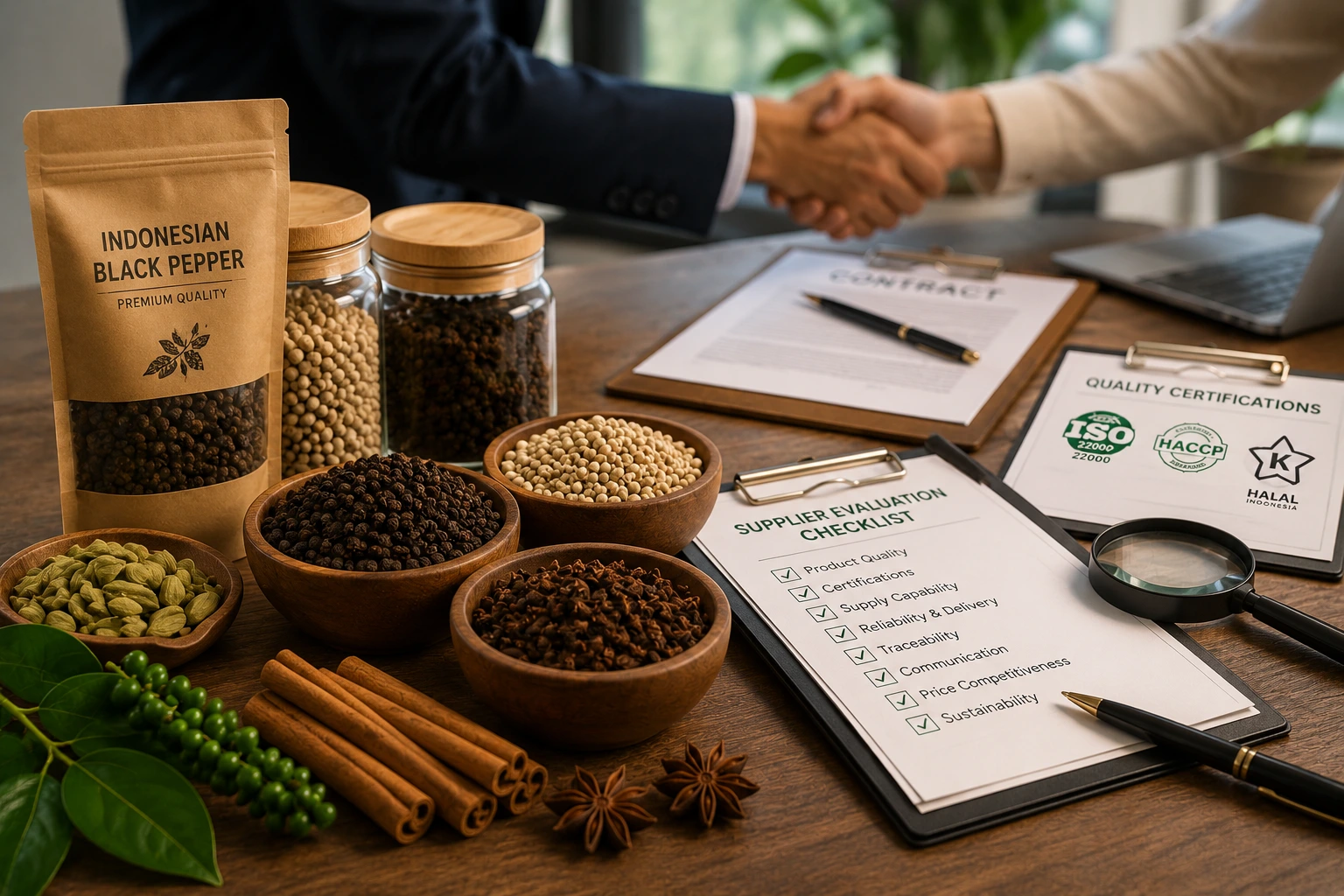
Why This Matters
Choosing a spice supplier is a decision with consequences well beyond the first shipment. A supplier that cannot maintain specification consistency, documentation discipline, or communication reliability creates recurring costs — rejected lots, customs delays, and production disruption — that a favorable initial quote rarely offsets. This guide sets out a structured evaluation framework for procurement teams assessing spice suppliers, whether for a first trial order or a long-term supply agreement.
Who This Guide Is For
Written for procurement managers, spice distributors, food manufacturers, and private label companies responsible for vetting and selecting bulk spice suppliers.
Why Supplier Selection Deserves a Formal Process
Informal supplier selection — based primarily on price and a single sample — tends to surface problems only after commercial commitment: a second shipment that doesn't match the first, a certification claim that can't be verified, or a documentation gap discovered at customs. A formal evaluation process shifts that discovery earlier, before it carries commercial cost.
Core Evaluation Criteria
1. Quality System and Consistency
Ask specifically:
- What quality-control checkpoints exist between harvest/procurement and shipment?
- How is lot-to-lot consistency managed when sourcing from multiple smallholders or regions?
- Is testing conducted in-house, by a third-party lab, or both?
- Can the supplier provide a Certificate of Analysis matching your specific specification, not a generic product sheet?
Buyer Tip
A supplier who can describe their quality process in specific, procedural terms — rather than general assurances — is demonstrating an actual system, not just a claim.
2. Documentation Discipline
Export documentation errors are one of the most common causes of customs delay. Evaluate whether a supplier:
- Routinely provides complete documentation (Commercial Invoice, Packing List, Certificate of Origin, Phytosanitary Certificate, CoA) without buyer prompting
- Understands destination-market-specific requirements, not just Indonesian export requirements
- Has a track record of accurate, consistent documentation across past shipments (ask for references where appropriate)
3. Certification Verification
Never accept a certification claim at face value. For any claimed certification — organic, ISO, HACCP, Halal, or other — verify directly with the issuing body rather than relying on a supplier-provided certificate image alone. This is standard due diligence, not an unusual request, and a credible supplier will not be offended by it.
4. Traceability
Ask how far back a supplier can trace a given lot — to a specific region, cooperative, or estate, versus only to a generic "Indonesia" origin claim. Traceability matters for:
- Responding to a product recall
- Satisfying your own downstream customers' supply-chain transparency requirements
- Confirming consistency claims are verifiable rather than asserted
5. Supply Capacity and Scalability
A supplier who performs well on a small trial order may not have the capacity to support your full projected volume. Confirm:
- Current production/aggregation capacity relative to your anticipated order size
- Peak-season versus off-season capacity, particularly for seasonally harvested commodities
- What contingency exists if a harvest shortfall affects supply
6. Communication and Responsiveness
Communication quality during the sales process is a reasonable — though not perfect — predictor of communication quality after a contract is signed. Evaluate:
- Response time to technical questions, not just commercial ones
- Willingness to discuss specification details, documentation requirements, and quality-control processes directly
- Clarity and completeness of answers, versus vague reassurance
Supplier Evaluation Scorecard
| Criterion | Questions to Ask | Red Flag |
|---|---|---|
| Quality System | Describe your QC checkpoints | Vague or unwilling to describe process |
| Documentation | Provide a full document set for a past shipment | Missing or inconsistent documentation |
| Certifications | Provide certificate numbers for independent verification | Unwilling to allow verification |
| Traceability | Trace this lot to region/estate level | Can only confirm country-level origin |
| Capacity | Confirm capacity against my projected volume | Non-specific capacity claims |
| Communication | Response time and technical depth during RFQ | Slow, generic, or evasive responses |
Red Flags to Watch For
- Unwillingness to provide a Certificate of Analysis before commercial commitment
- Certification claims that cannot be independently verified with the issuing body
- Reluctance to discuss documentation requirements for your specific destination market
- Pricing significantly below market range with no clear explanation (e.g., different grade, different specification)
- Inconsistent answers to the same technical question asked at different points in the sales process
None of these individually disqualifies a supplier automatically, but each warrants closer scrutiny before proceeding.
Trial Orders: A Practical Risk-Reduction Step
For a new supplier relationship, a smaller trial order — sized appropriately to test both product specification and process reliability — is a reasonable way to validate the criteria above before committing to a full-volume agreement. A trial order should be evaluated not just on whether the product met specification, but on whether documentation, communication, and timeline commitments were also met.
Building a Long-Term Supply Relationship
Once a supplier has been selected, reliability is maintained — not assumed — through:
- Periodic re-verification of certifications, since certification status can lapse or change
- Ongoing specification confirmation via CoA on each shipment, not only the first
- A clearly agreed process for handling a specification deviation, established before one occurs
- Regular communication about capacity, particularly ahead of your own peak-demand periods
Export Insight
Use the evaluation criteria and scorecard in this guide to assess any spice supplier you are currently considering, including IndoSpiceHub. We welcome direct questions about our quality-control process, documentation practices, and certification status as part of your due diligence.
Common Mistakes When Selecting a Spice Supplier
Selecting primarily on price
Selecting primarily on price without confirming specification match.
Treating one sample as proof of consistency
Treating a single strong sample as proof of ongoing consistency.
Skipping certification verification
Skipping independent certification verification with the issuing body.
No documented dispute process
Failing to establish a documented process for handling quality disputes before they occur.
Not asking about scaled capacity
Not asking about capacity relative to projected volume, only relative to the current trial order.