Why This Matters
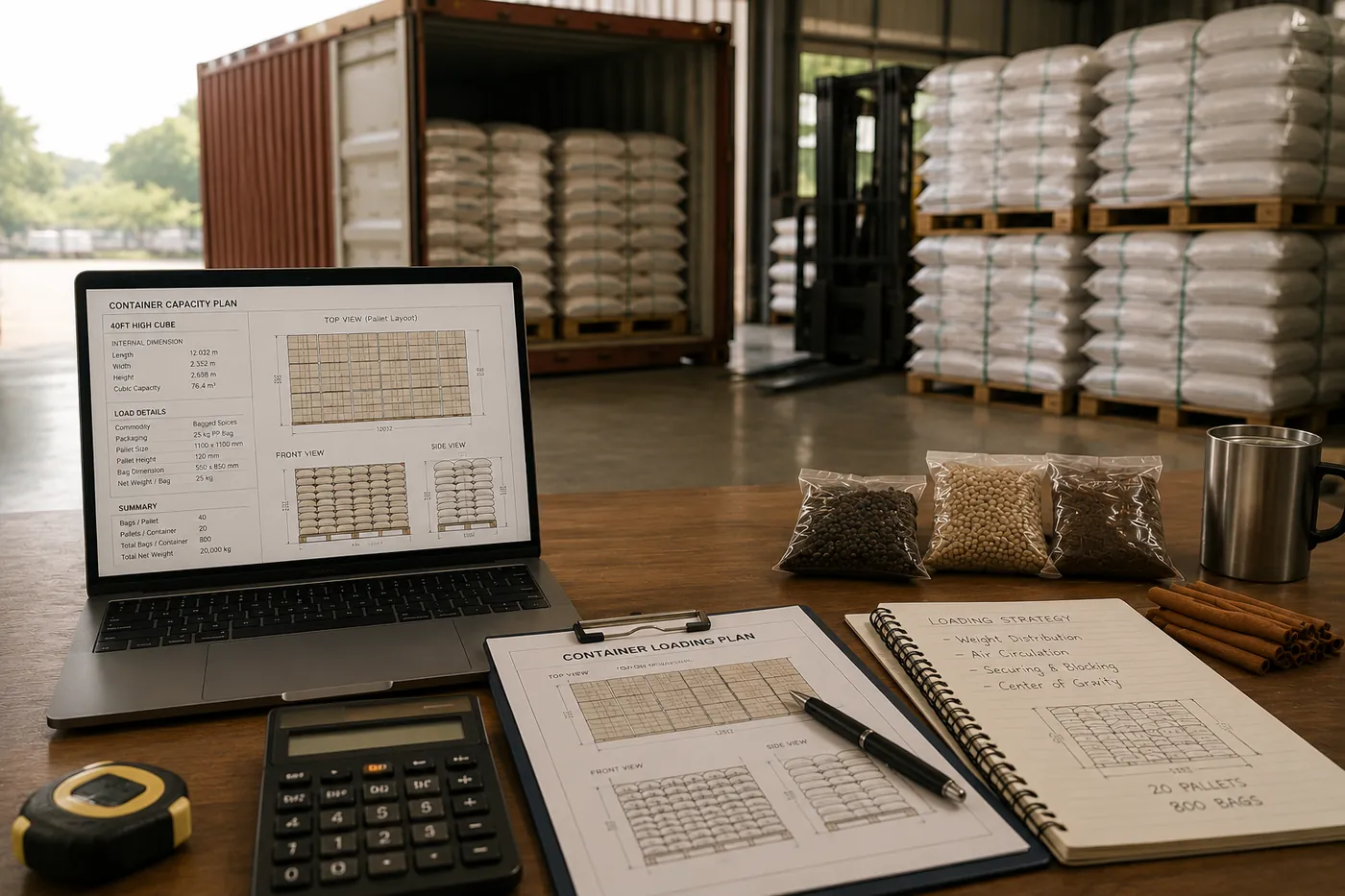
Efficient container planning is one of the most important stages in international spice exports. A well-planned container not only maximizes available space but also helps protect product quality throughout the voyage.
For importers, understanding how export containers are planned provides greater confidence when evaluating suppliers and comparing quotations.
Many buyers assume container capacity is simply calculated by volume.
In reality, experienced exporters consider a wide range of operational factors including product density, packaging dimensions, container weight limits, ventilation, stacking patterns, and destination requirements.
Proper planning helps reduce transportation costs while minimizing the risk of cargo damage during long ocean voyages.
Why Container Planning Begins Before Loading Day
Container loading is not a last-minute activity.
Planning starts once the buyer confirms:
- Product specification
- Packaging format
- Bag weight
- Order quantity
- Destination country
- Preferred shipping schedule
These details determine how the cargo will be prepared inside the warehouse long before the container arrives.
Factors That Influence Container Capacity
Several variables determine how much product can safely be loaded into a shipping container.
Commodity Characteristics
Different products have different densities.
For example:
- Black pepper
- White pepper
- Cloves
- Cassia cinnamon
- Charcoal briquettes
Although two products may use the same bag size, their weight distribution can differ significantly.
Packaging Type
Container capacity depends on the selected packaging.
Common export formats include:
- PP woven bags
- Kraft multiwall bags
- Jumbo bags
- Cartons
- Private label retail packaging
Each packaging format changes stacking efficiency and pallet utilization.
Bag Weight
Typical export weights include:
- 25 kg
- 30 kg
- 50 kg
Lighter bags may improve manual handling, while heavier bags can maximize loading efficiency depending on destination regulations.
Container Weight Limits
Available space is not the only limitation.
Maximum allowable payload must also be respected.
An experienced exporter balances:
- Internal volume
- Gross weight
- Safe stacking
- Destination compliance
Pallet Configuration
Pallet planning is equally important.
Proper pallet patterns provide:
- Better warehouse handling
- Faster loading
- Reduced product movement
- Improved inventory control
- Easier unloading at destination
The chosen configuration depends on both packaging format and buyer requirements.
Moisture Protection During Ocean Freight
International sea freight exposes cargo to changing temperatures and humidity.
To reduce moisture-related risks, exporters may use:
- Moisture-barrier liners
- Protective inner bags
- Dry container inspection
- Proper pallet spacing
- Appropriate ventilation
The selected protection method depends on both commodity characteristics and shipping route.
Efficient Loading Does Not Mean Filling Every Space
A common misconception is that the best exporter always loads the maximum possible quantity.
In practice, overloading may:
- Increase cargo pressure
- Restrict airflow
- Complicate unloading
- Increase product damage risk
Professional exporters prioritize cargo stability rather than simply maximizing volume.
Export Insight
Container planning begins long before the truck reaches the warehouse.
Packaging decisions, pallet configuration, inspection scheduling, and loading sequences are coordinated in advance so that loading day proceeds efficiently without compromising product quality.
Common Buyer Mistakes
Requesting Packaging Changes After Production
Late packaging changes often require revised pallet calculations and loading plans.
Comparing Prices Without Considering Packaging
Different packaging formats influence logistics costs and usable container capacity.
Assuming Every Product Loads the Same Way
Each commodity has unique characteristics that affect stacking and weight distribution.
Ignoring Destination Requirements
Some countries or buyers specify pallet dimensions, fumigation standards, or labeling requirements that directly affect container planning.
Prioritizing Maximum Quantity Over Cargo Safety
Efficient loading should never compromise product protection during international transport.
Glossary
| Term | Meaning |
|---|---|
| FCL | Full Container Load |
| Pallet | Platform used for handling cargo |
| Payload | Maximum cargo weight a container can safely carry |
| Moisture Barrier | Protective layer that helps reduce moisture exposure |
| Container Stuffing | The process of loading cargo into a shipping container |
Key Takeaways
- Container planning begins long before loading day.
- Packaging format directly affects loading efficiency.
- Safe loading is more important than maximum volume.
- Moisture protection should be considered for international sea freight.
- Proper planning helps maintain product quality throughout the journey.