Why This Matters
Indonesia is one of the world's leading suppliers of Cassia cinnamon, supplying manufacturers, wholesalers, distributors, food processors, and retail brands across international markets.
Although many buyers simply request "cinnamon," export transactions require much greater precision. Different grades vary in appearance, thickness, color, aroma, cleanliness, and intended application.
Understanding these differences allows buyers to specify exactly what they need while reducing quality disputes after shipment.
A quotation for "Cassia Cinnamon" provides very little technical information.
Professional buyers instead specify measurable characteristics such as:
- Product form
- Moisture requirement
- Length
- Thickness
- Color
- Cleanliness
- Packaging
Defining these specifications early helps both exporter and buyer avoid misunderstandings during production.
Understanding Indonesian Cassia Cinnamon
Cassia cinnamon comes from the dried bark of cinnamon trees cultivated in Indonesia's major producing regions.
After harvesting, the bark is carefully processed, dried, sorted, and packed for export.
Unlike culinary descriptions found in retail markets, export-quality cinnamon is evaluated using practical characteristics that affect manufacturing performance, storage stability, and presentation.
Common Product Forms
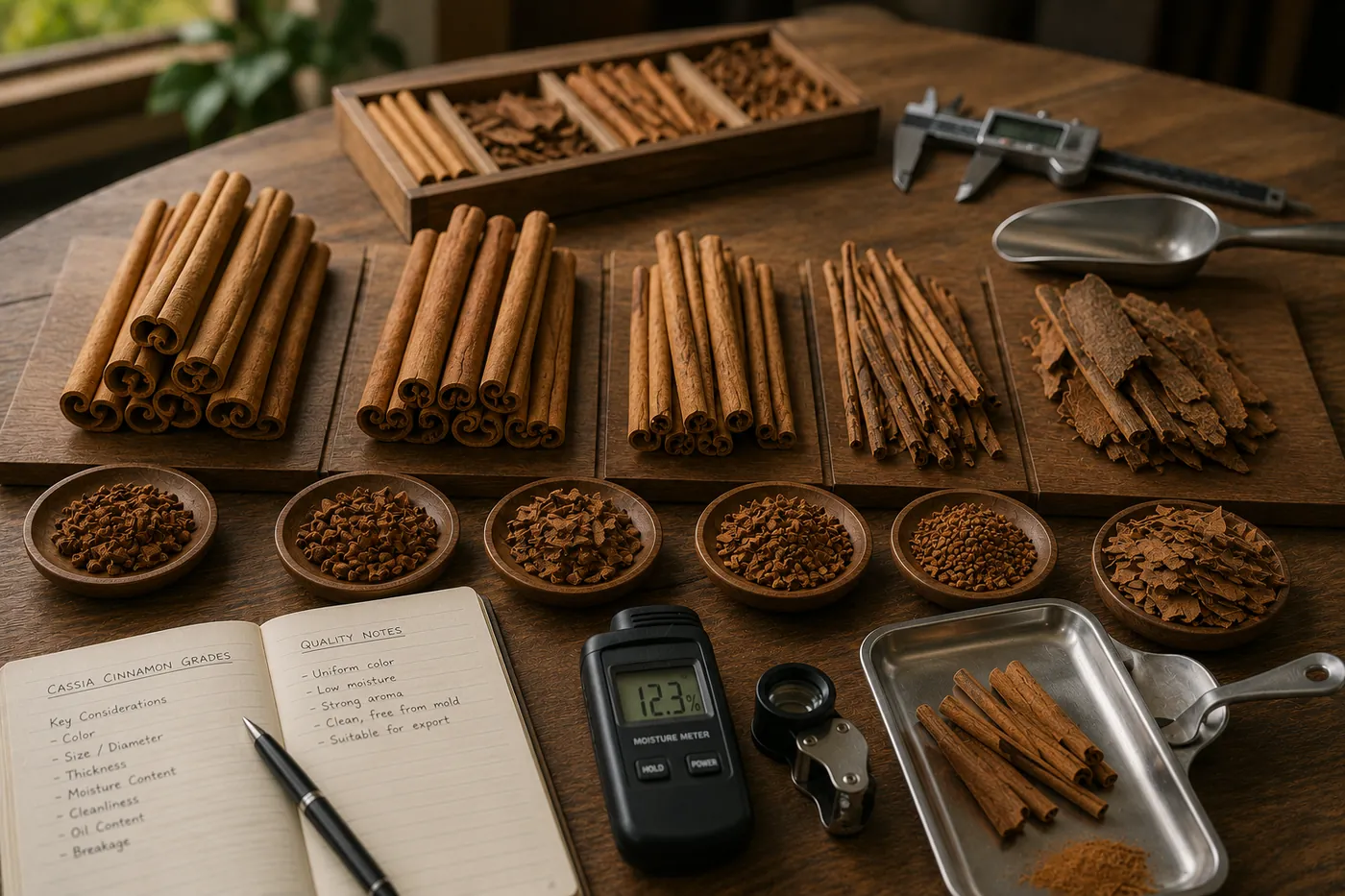
Cassia cinnamon is exported in several forms depending on buyer requirements.
Typical export products include:
- Whole quills
- Cut quills
- Broken pieces
- Split cassia
- Cassia sticks
- Ground cinnamon (upon request)
Each product form serves different manufacturing and commercial applications.
Key Quality Factors
1. Appearance
Professional buyers expect a shipment with consistent visual quality.
Inspection typically considers:
- Uniform shape
- Smooth surface
- Natural appearance
- Limited damage
Consistency improves both processing efficiency and customer presentation.
2. Thickness
Thickness affects:
- Processing suitability
- Product appearance
- Packing efficiency
Different buyers may require different bark thickness depending on their production process.
3. Color
Export-quality cassia generally displays a warm reddish-brown color.
Significant color variation may indicate differences in drying conditions or natural harvest characteristics.
Color should always be evaluated together with aroma and cleanliness.
4. Aroma
Cassia cinnamon is valued for its naturally warm, sweet, and spicy aroma.
Proper harvesting and drying help preserve these characteristics throughout storage and shipment.
Weak aroma may result from:
- Poor storage
- Extended storage periods
- Improper drying
- Moisture exposure
5. Cleanliness
Cleaning removes unwanted material before packaging.
Inspection generally checks for:
- Dust
- Bark fragments
- Foreign matter
- Excess debris
A cleaner shipment improves production efficiency for buyers.
6. Moisture Condition
Maintaining suitable moisture levels helps preserve:
- Product stability
- Aroma
- Appearance
- Shelf life
Proper drying is essential before export packaging begins.
Selecting the Right Grade
The most suitable grade depends on the intended application.
Food Manufacturers
Often prioritize:
- Consistency
- Aroma
- Moisture control
- Stable supply
Retail Brands
Usually focus on:
- Attractive appearance
- Uniform size
- Packaging quality
Spice Processors
Frequently emphasize:
- Processing efficiency
- Cleanliness
- Product consistency
Understanding the final application allows exporters to recommend the most appropriate specification.
Packaging Options
Packaging protects cinnamon during transportation and storage.
Common export packaging includes:
- PP woven bags
- Kraft multiwall bags
- Moisture-barrier liners
- Cartons for retail products
Packaging format should always be selected according to shipment route and buyer requirements.
Why Product Samples Matter
Representative samples remain one of the most effective ways to confirm product suitability.
Sample evaluation allows buyers to verify:
- Appearance
- Aroma
- Thickness
- Packaging
- Overall quality
Sample approval should be completed before production begins.
Quality Inspection Before Shipment
Before loading, export-quality cassia cinnamon should be inspected to verify:
- Product specification
- Packaging condition
- Labeling
- Quantity
- Physical consistency
- Shipment readiness
Documented inspection reduces uncertainty for both exporter and buyer.
Export Insight
Professional exporters do not simply ship cinnamon after production.
Each shipment follows a structured process including sourcing, inspection, sorting, packaging verification, and pre-loading review to improve consistency across repeat orders.
Comparison Checklist
| Inspection Item | Why It Matters |
|---|---|
| Appearance | Visual consistency |
| Thickness | Processing suitability |
| Aroma | Product quality |
| Cleanliness | Manufacturing efficiency |
| Moisture | Storage stability |
| Packaging | Transportation protection |
Common Buyer Mistakes
Ordering Only by Price
Price differences often reflect differences in sorting, cleaning, packaging, or product consistency.
Using Generic Product Names
"Cinnamon" alone is rarely sufficient for export quotations.
Detailed specifications help suppliers prepare more accurate offers.
Ignoring Packaging Requirements
Packaging should match both the commodity and the shipping route.
Skipping Sample Approval
Approving a representative sample before production helps reduce quality disputes.
Assuming Every Supplier Uses Identical Grades
Grade terminology varies between suppliers.
Always request measurable product specifications rather than relying on marketing descriptions.
Glossary
| Term | Meaning |
|---|---|
| Cassia | The most widely exported type of cinnamon from Indonesia |
| Quill | Whole rolled cinnamon bark |
| Moisture Content | Water remaining after drying |
| Foreign Matter | Materials other than the intended product |
| Sample Approval | Buyer confirmation before production |
Key Takeaways
- Product specifications are more important than marketing grade names.
- Thickness, aroma, and cleanliness are major quality indicators.
- Packaging should match the destination and shipping route.
- Sample approval reduces purchasing risk.
- Consistency is achieved through inspection and controlled export preparation.